Showing posts with label exploration. Show all posts

Wednesday, March 9, 2011

9: Carnaval Holiday: Lisbon, Terror, and Paris


If any of you reading this have been bored by my recounting of classes and grocery shopping, this blog post is definitely for you.  Just be prepared for a pretty long account.

Ora and Portuguese food: Arroz de Marisco
This weekend was Carnaval in Portugal, but since we had both Monday and Tuesday off from class, my friends and I decided to forgo the Portuguese celebrations and travel farther out into Europe.  While we planned on meeting in beautiful Paris on Sunday night, the weekend separated all of us: Dan and Amy met Amy’s boyfriend James in London; Tatiana flew off to visit her boyfriend in a town outside of Paris… and I went to Lisbon with the wonderful Ora Star, who came to visit me during her spring vacation!  

It was amazing and surreal to have someone from home here, which is so different from Rhode Island and Maryland.  Ora arrived Friday evening.  I met her at the train station, forced her on a death march up the many hills of Coimbra to my apartment, and then we spent the night getting dinner and wandering around Universidade Velha and the riverside.  We passed out early to the melodious sounds of the latest Jersey Shore episode, and then woke up early that morning to catch the train to Lisbon.  

A Brasileira, where famous Portuguese writers and thinkers would meet and eat
Hanging with A Brasileira regular Fernando Pessoa


SATURDAY
Entrance of Sao Jorge Castle

Alex, Ora, and Lisbon
Our train arrived much earlier than we thought it would, so we called our hostel from the train station and they said that we could drop off our bags before official check-in at 3 PM.  We bought cheap day-passes for Lisbon public transportation (if anyone ever comes to Lisbon, this is the VivaViagem card is the greatest thing in the world) and did the first of three walking tours listed in my Rick Steves book (Rick Steves is the greatest tour guide of all time).  We went through the Bairro Alto and Chiado neighborhoods, which I remembered from my 2008 visit with my family, and ended up near the famous A Brasileira restaurant and a huge shopping center where Ora found her favorite part of Portugal: a Sephora and Starbucks right next to one another.  We hopped back to the hostel to check in after that, then walked through the Alfama neighborhood, which started at one of my favorite parts of Lisbon, São Jorge Castle.  We didn’t go in, as it cost too much money and we were both on a serious budget, but we ended up hanging out around the outer wall and surveying the shops around the area.  We also got free porto, or Port wine, though it wasn’t the most enjoyable experience.  I couldn’t tell if I just don’t have a taste for the strong liquor or it was just terrible, free Port.  I’m hoping it’s the latter or else I am failing at being truly Portuguese.  

Praca do Comercio and the Arc de Triumph
We walked around the Baixa neighborhood, which is definitely the most metropolitan area of Lisbon.  It has the most history anyway, with giant plazas like the Praça do Comércio with its Arch of Triumph, and all the new architecture that replaced the destroyed buildings after the 1755 Earthquake/Tsunami/Fire (Portuguese people have the worst luck).  There Ora also tasted her first small cup of ginjinha (which, though I sang his praises earlier, Rick Steves has wrong: You don’t say “sem/com elas” if you want fruit.  You just say “sem/com frutas.”  Nice and simple.  None of those messy prepositions.)  While I think she definitely enjoyed it more than the porto, I don’t think Ora will be buying a bottle anytime soon.

Pasteis de nata and galao
After that walking, we waited for the bus and went to Belém, which is kind of a separate district of Lisbon.  We got there pretty late, so it was rather dark and had started to rain, but we walked over to the Monument of the Discoveries and stood outside of the Monastery de Jerónimos.  We also went over to my mom’s favorite place in Portugal, a Casa Pasteis de Belém, who claim to have invented pasteis de nata (which I’ve mentioned in this blog before).  We ate two there and got two to go for the next day.  


SUNDAY


The next morning we went to the Gulbenkian, which was just as amazing the second time.  I absolutely love that museum, especially when I think about how every single beautiful thing in there was owned by one singular man.  It is all a thank-you from Calouste Gulbenkian, an Armenian oil tycoon who found refuge in Portugal during the Second World War.  He willed his amazing art collection to the country after he died to thank them for harboring him and his family.  Must see when you come to Portugal (because you should).

After the museum, we shot over to the train station to buy tickets to Porto, from which I was flying to Paris that night and Ora was flying to Madrid the next afternoon.  We ate delicious Chinese food at a huge mall-like complex near the station before riding the train.  In Porto, we tried to find the hostel where Ora would spend the night, but the hostel owner’s heavily accented English was more confusing than helpful and Ora ended up taking a cab while I got back on the metro and rode to the airport.

Despite causing a little bit of drama getting on the plane because I didn’t go to the check out desk (as I thought that, as it is in the US, one does not need to check in if they have already done so online… but this is Europe.  I keep forgetting), I boarded the plane just fine and turned off my phone in preparation for the flight.  Amy and Dan had flown from London to Paris that afternoon and were taking in the views from the Eiffel Tower as I was boarding.  That news would be the last I heard from them for about 12 hours.

We landed in Beauvais that night, and unaware that anything was about to go horribly wrong, I retrieved my phone and turned it on to text my friends that I had landed and would see them in a little over an hour.  However, when my phone turned on, it suddenly asked for a pin number.  I had no recollection of any such pin number, and after plugging in all the numbers I could think of and all the numbers I could find printed on and inside the phone, the SIM card blocked the phone and all information I had on it.  I had no way to look at my texts, which included the metro stop where my hostel was located, or my contacts, where Dan and Amy’s numbers were listed.  Walking to the shuttle which brought Beauvais fliers into the city, I decided that I would drive in, figure out the metro, and find my friends.  I allowed myself to get a bit hysterical on the shuttle, but when we pulled into the Middle of Nowhere, Paris, France, it was time to act.

By the time I arrived in the city of Paris, it was about 11:30 PM.  I’ve never been a particularly street smart individual, so how I managed to find the metro, figure out the machines which were stubbornly only in French, read the metro stop, and make a transfer to the metro stop I remembered from earlier, are all completely beyond me.  But at 1 AM, I exited the Voltaire stop and realized that, unless our room was directly overlooking the metro stop, I would never find them.  I wandered the empty plaza for a few minutes and then gave up.  

This might be the point where you might think, “Dear God, this 20-year-old girl is walking around a city at one in the morning, suitcase and travel book in hand and absolutely not phone or knowledge of the French language to speak off.  This is going to turn into a real-life version of Taken.”  However, I wasn’t completely lost.  The week before I had contacted Hayley, a Brown student I had only met once before at a party.  Her family were the hosts, and my godfather and his family were one of the many guests.  They had invited me along, and while Hayley and I had never seen each other before on campus,  we traded information about our study abroad plans.  I remembered she was in Paris while planning the trip with Amy and had sent her an email, and her response, which included helpful phrases, amazing sites, valuable advice… and her phone number, had been printed and put in a folder with the rest of my travel documents.  I went into a restaurant that was still open (that would have never been an option in Coimbra) and, through the miracle of universal hand signals, managed to borrow one of the waiter’s cell phones and call her.  By the grace of God, she picked up and immediately gave me the address of her friend’s house, where she was staying that night.  I took a cab and met them there, sent a mass-message on Facebook to everyone in my Portuguese program in an effort to somehow let Dan and Amy know that I was alive, and passed out on a wonderful make-shift bed.

MONDAY

Post-drama: In front of Notre Dame
The next morning, after not one response to my Facebook message, Hayley and I tried to figure out how to get in touch with Dan and Amy, who had no Internet access.  I realized that I had a small notebook in my purse in which I had written my landlord’s phone number and his son’s email address.  After sending an email to his son, Hayley graciously put credit on her Skype account and allowed me to call my landlord.  He and his son sent me Tatiana’s number, who I also called on Skype, and who answered the phone hysterically.  Dan and Amy had been texting and calling her all night just in case she had heard from me.  The theories ranged from plane crash to kidnapping, but after I assured her that I was completely fine, she was able to contact Dan and Amy and coordinate for us to meet in front of Notre Dame that morning. Hayley brought me there herself and waited with me.  I could not be more grateful to her and her friend Sarah.  They are truly the nicest people of all time.

Saint-Chapelle

The Pantheon

After that, the excitement of the day moved from anxious terror to excited amazement.  With luggage in hand, Dan, Amy, and I took copious amounts of photos of Notre Dame, Sainte-Chapelle (one of the most beautiful places I’ve ever seen), Place St. Michel, the Sorbonne, and the Pantheon (what I deemed to be France’s secular attempt at a Westminister Abbey type establishment, with their history painted beautifully across the walls and a crypt where many famous French thinkers, writers, politicians, and scientists are buried).   

The Sacre-Coeur
Coming out of the Pantheon, we met up with Tatiana and her boyfriend Laurent, both of whom were in the city for the day, and then parted ways again to go see the Basilique du Sacré-Cœur, which was amazingly beautiful and had such a good view.  Despite Dan almost punching a street vendor who tried to scam us, it was a perfect place to watch the sun set and take artsy photos of the Eiffel Tower in the distance.  After the sun went down, we went to the Champs-Élysées and had dinner at the classiest McDonalds I have ever been inside.  Afterwards we returned to the hostel and fell asleep to French-dubbed “Gone in 60 Seconds” And “Top Chef.”

Hamming it up on the Champ-Elysees


TUESDAY

The main Entrance to Versailles

The next morning we woke with the dawn (or 7:30 AM) in order to get to Versailles when it opened at 9 AM.  This was the biggest, most necessary thing I wanted to do during this trip, so even through the exhaustion I was completely elated.  Arriving in the town of Versailles was fantastic, and then turning the block and seeing the main entrance to the palace was breath-taking.  I can’t say that I have no words for the interior, because I have millions of words: amazing, wonderful, enchanting, incredible, beautiful, stunning… The list goes on and on. 

In the Hall of Mirrors
I often hear people comparing Western art, style, and culture to that of the East and using the “exotic” aspects of the latter to make it seem better and more sensual to the European way of life.  After living, studying, and visiting Europe, all that seems absolutely ridiculous.  European cathedrals are just as dramatic and gorgeous as Indian palaces and Asian temples.  Go to Versailles and Paris, go to Lisbon and Coimbra, and tell me that those places aren’t exquisitely beautiful, graceful, sensual, and magnificent.  If your views are still plagued by the legacy of European imperialism, you need to study history a little bit better.  Versailles was everything I could have wanted it to be, and the audio tour was comprehensive and wonderful (I especially loved the specific voices that would only read whenever they were sharing a specific quote from a specific French king or dauphin).  Despite the multitude of tourists, even that early in the morning, this was definitely the highlight of my trip.  I even loved the Japanese school girls taking jumping photo after jumping photo, their fingers making “V” For “Versailles”… that’s what I’ve decided, anyway. :)

The Travelers, reunited.

The gardens outside of the palace, while rather dead due to the time of the year, were amazing all on their own.  The amount of land there is incredible, and the gardens stretch out (it seems) forever.  A tourist can actually rent a bike to tour the gardens alone.  After failing to convince my friends to eat at a Tex-Mex restaurant, we ate sandwiches in the town and then headed back to Paris.  We again whirled around the city, visiting the Rodin gardens, the Army Museum, and the Orsay, which was sadly closed by the time we got there.   

Rodin Gardens


The exterior of the Army Museum
Awkward with the Sarcophagus of Napoleon
Rhino statue outside of the Orsay
After dinner at “Ming Dynasty,” which served sushi, we took a boat cruise on the Seine and took pictures of buildings like the Louvre, Notre Dame, and the Eiffel Tower at night.  It was absolutely beautiful.  After the boat tour we stomped around until we found a creperie.  Then it was back to the hostel and back to bed, because the next morning we actually did wake up with the dawn.
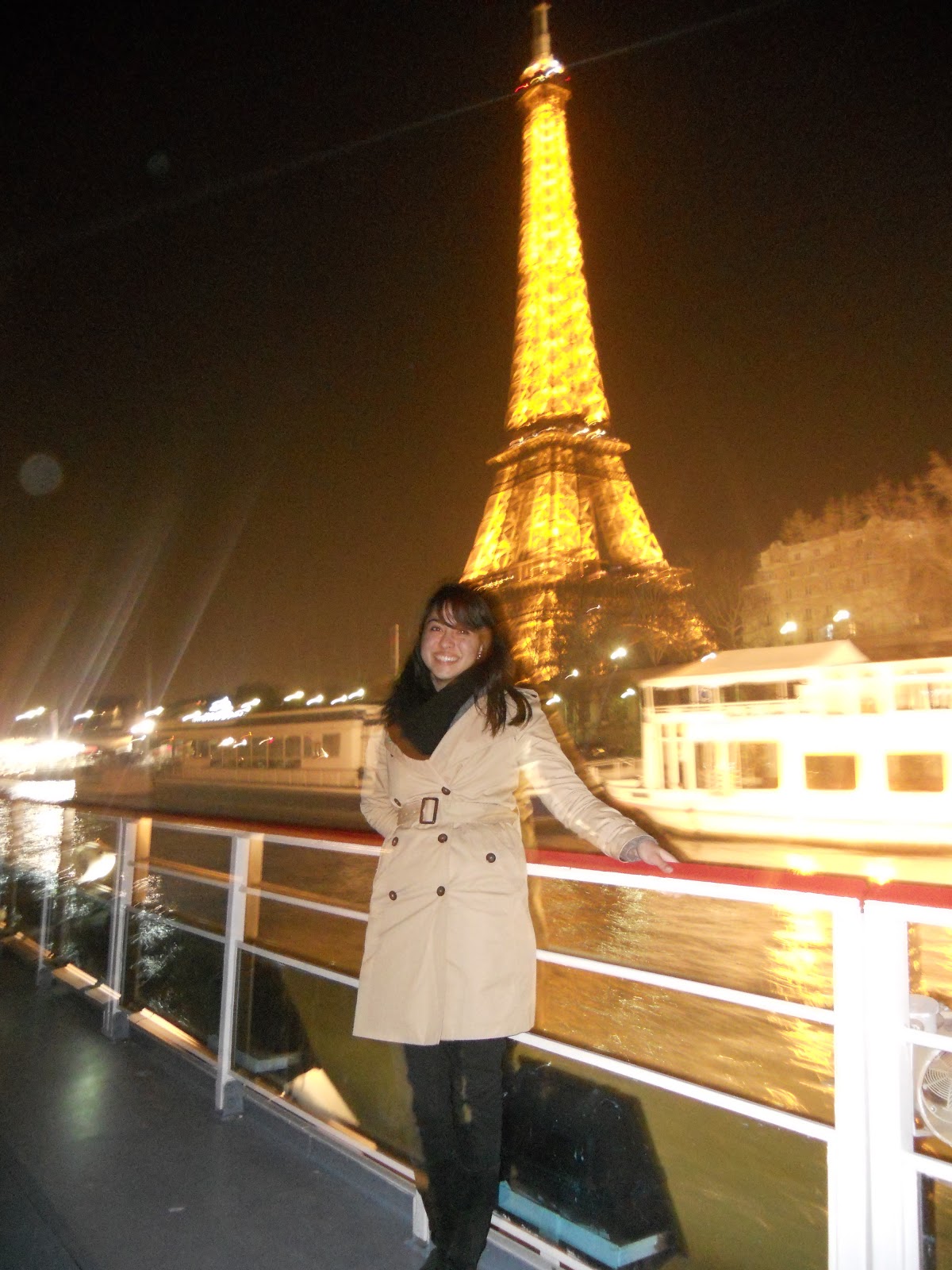
Customary with Eiffel Tower shot

WEDNESDAY

Checked out at 5:30.  Took the metro to the shuttle at Port Maillot.  We left there at 6:30 and got to Beauvais at 7:30.  We weren’t able to check in until 8 AM and didn’t find out our gate until almost 9:30, but soon we were in Porto.  We rode the metro then to the Campanha bus stop, had lunch in a nearby café (where we remembered how wonderfully cheap and broke Portugal is), and then left Porto for Coimbra at 12:52 PM.  We got back to our favorite Portuguese city just in time for Dan and I to run to Portuguese History at 2 PM.

All in all, I’d say a very good, busy, exciting, adventurous weekend.


Sunday, February 20, 2011

7: The Conímbriga Ruins

02/20/2011

Get ready for a picture-heavy post! 

I had to edit my date above when I realized that most people reading this blog probably don't put the date before the month... I'm getting used to Portugal very quickly.

This weekend Amy took a extremely long bus ride to Spain and most of our buddies were off around Portugal, so Tatiana and I decided to do a day trip to the Conímbriga ruins.  According to Rick Steves (Who, if you didn't know, is the best travel book author OF ALL TIME), these ruins are impressive and second only to those in Rome.  Of course, reading that description, my Ancient-Rome-ophile mind desperately needed to see these ruins, and conveniently, they were only a 20-minute bus ride away from Coimbra.

The clock at the Coimbra A station.  At noon.
Public transportation in Portugal is, to say the least, a little worse than what we might be used to in America.  In America, for instance, we like bus schedules that are readable, expect buses to be either frequent or on time (probably has something to do with every single public clock having a different, and usually incorrect, time), and don't have the previously described circuit system that will either make your travel time seven minutes or an hour and twenty.   At least in DC, our bus drivers tend to understand a round-a-bout and don't almost get into accidents in any and every round-a-bout they enter.  Well here in Portugal, we experienced a whole new problem with buses: the width of roads.  While a little comparable to the roads in Annapolis, European roads are actually ridiculously thin.  If you aren't on a highway, there is a definite chance that your vehicle will be merely inches away from another vehicle passing in an opposite direction. Our bus to the ruins actually had to stop in the street because one driver didn't parallel park close enough to the curb and the bus couldn't pass.  We sat there for twenty minutes as the bus driver (who, in a fun aside, resembled contemporary Alec Baldwin) and the people in a nearby cafe tried to get in touch with the driver, and the cars behind us honked and honked.  Only in Portugal.

Finally we got to the ruins, and while it drizzled every now and then, the sights were incredible.  For only 1,60 € we were able to see the entire facility (I love this Euro26 program!).  


The swastika design
 
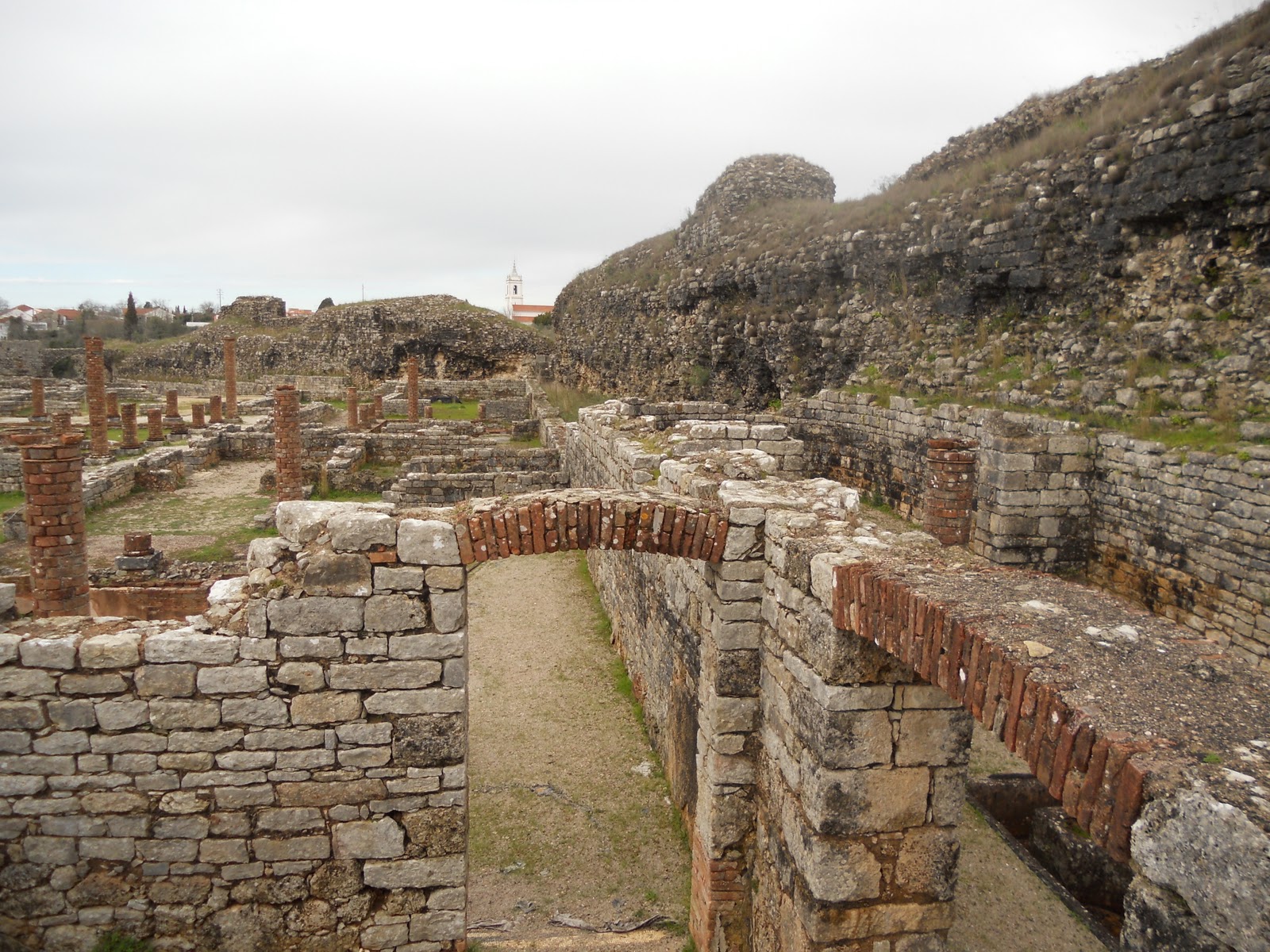
First, as Rick Steve's suggested, we saved the museum for last and started on the ruins.  The first area was what used to be a house with the most beautiful mosaic floors I've ever seen.  I could not believe that it was that well preserved, though I'm sure some restoration had occurred.  This house is referred to as a Casa da Cruz suástica, or the House of the Swastika, because there is a hallway with the design in the mosaic.  Of course, for the ancient Romans, the symbol didn't have much to do with Hitler, but was more of a symbol for solar restoration.


The furnaces for the ladies' bath


Right next to this was a small bath facility which they are still excavating.  I love how excavators can identify for what each room was used.  


The House of Cantaber (it goes on)
Down a little hill was this HUGE area where Cantaber, the main aristocrat of Conímbriga, had built his home.  The area was massive, even for modern standards.  Next to this was a home that had later been converted into a cathedral, but unfortunately the ruins had been pretty badly destroyed and they didn't know much about the church or its layout.


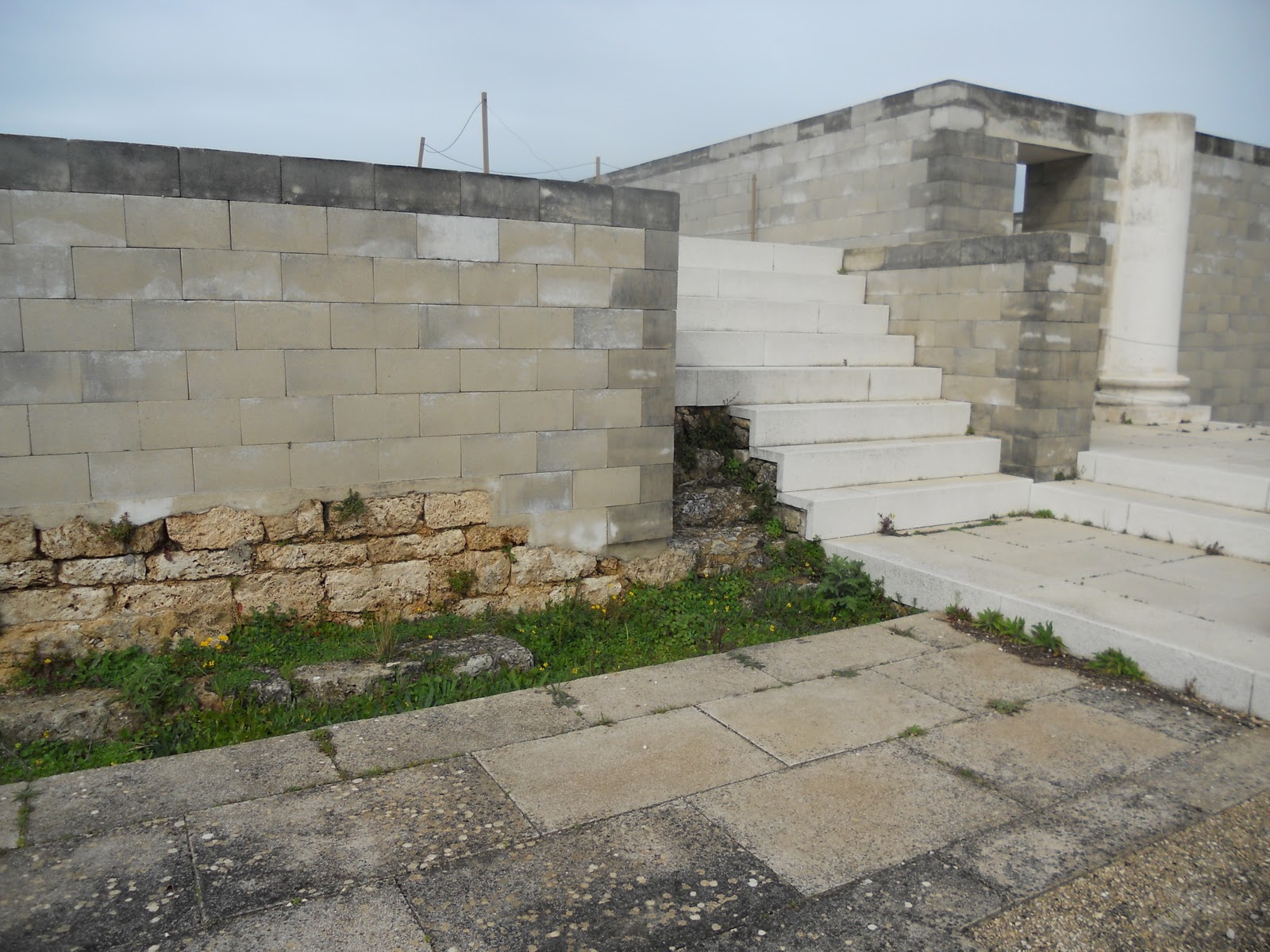
The Forum (now)
The original stone under the new

The Forum (then)
Then there was the Forum, which was highly reconstructed but still really neat.  I'm sure that many of the original stones had fallen over, but where original stone remained, the builders let it show beneath the newer white brick.  I loved that they did that.  They had even placed a few pillars on the side to give the tourist a better idea of what it had looked like.  In the museum, later, they had built a miniature replica of the Forum and the temple behind it.  


Indigenous ruins


Underneath the temple, the excavators had found all these destroyed structures from the indigenous people that the Romans had probably killed and replaced.  Two kinds of ruins for one!


The view from the Termas do Sul


The other huge area was the Southern Bathhouse (As Termas do Sul), which they have also started to rebuild a little bit.  It was massive and beautiful, and it has an amazing view of the valley and the river.  I could only imagine how nice it must have been to go there as a Roman.  


The garden of the House of Fountains

No matter what era, there will be fish in Portugal.
We walked back through the ruins and went to the "main attraction" of the ruins, A casa dos repuxos, or the House of Fountains, which was under a protective structure.  I had been so impressed by the mosaics in the previous house, but these designs weren't just geometrical.  There were gods, animals, and people in these floors.  Amazing.  Apparently there was some sort of fountain show in the middle, where the facility had planted a garden and flowers, but Rick Steves told us not to waste the money (you're the best, Rick).  


The (mostly) completely intact kitchen ware.
After a huge buffet lunch at the museum restaurant and some inspiration for a couple new dinner ideas, we made our way to the small but fantastic museum.  Such a well laid-out and marvelous collection.  Many of the artifacts that they found in the ruins are now housed inside, and the huge wealth of things that were in amazing condition was so impressive.  They had whole huge clay bowls and scissors!  The scissors absolutely blew my mind.  This is why I love going to see ruins and learning about history: because no matter how many centuries separate you and the people you are learning about, there are those little things that remind you that human beings are still pretty damn similar.

The scissors.  Blew my mind.

My new stone lion friend.  You know, because I have a lot of stone lion friends.

After the ruins and buying a few postcards, we went outside and waited for the bus.  The driver had told us that he was returning at 5 PM, but no bus came until about 6:30 PM (I'm adopting the "T.I.A." phrase from "Blood Diamond."  T.I.P.  This is Portugal).  At least Tatiana and I had a good time taking pictures and generally being ridiculous in the parking lot.  There was also a tour bus of young European guys who tried yelling to us from their bus in several languages to figure out where we were from.  Of course, each thing they yelled was along the lines of, "I love you!  Marry me, gorgeous girls!"  When they drove away, one of the guys popped out of this window and sang, "Goodbye my lover!  Goodbye my friend!"  After ignoring them for nearly half an hour, we couldn't stop laughing and I blew him kisses right back.  I think you have the guts to pull out James Blunt songs, you definitely deserve that.


That night we got back, made taco meat, black beans, and guacamole and watched Jane Eyre Part 1.  I might be becoming a little more European, but some things never change.

Tuesday, February 8, 2011

3: Arrival


02/6/2011

I finally have a good slice of time and an Internet connection, so its time for the very first post that I’m writing from Portugal.

Azulejos
This country is absolutely beautiful.  My program is through the University of Coimbra, which is one of the oldest schools in the world: founded in 1290 by the Pope, some of the buildings on campus are ancient and beautiful.  The Universidade Velha, the oldest part of the University, has a courtyard which looks over the entire city and the river.  One of the best views I’ve ever seen.   But honestly, the entire city of Coimbra is beautiful.  The houses are light colors with red roofs, black grates, and unkempt white-washed walls.  There is amazing tiles everywhere, decorating the outside of houses, the inside walls.  So many houses and buildings are bordered with these blue tile designs that are about as high as your shoulder.  These tiles are called “azulejos” and I wish the entire world could be covered in them.  But then again, I am a bit prone to exaggeration.

A gift store in the Porto airport


The trip here was crazy.  I was up for a day and a half straight and used every single modern mode of transportation other than a motorcycle.  Thursday: Drive to DC to get my visa at 9 AM; drive to Union Station; take a MARC train to BWI Airport, where my mom picked me up and brought me to the terminal; flight to Newark at 1:40 PM; Shuttle from terminal B to terminal C; flight to Porto with new friend Amy, another person in my program; flight from Porto to Lisbon at 7:40 AM (Portuguese time.  American time: 2:40 AM); Taxi from Lisbon airport to train station; Train to Coimbra B station; Taxi to Polo III, my home for the next five months.  So in all:

2 cars
2 taxis
3 airplanes
1 train
1 shuttle

My room!
I can’t sleep on planes, so by the time we got to Polo III, Amy and I were absolutely exhausted.  Carlos, who runs the dorm and who is basically a male House Mother, gave us our keys (we have about six to different locks all over the residence), but I was too tired to understand English, let alone Portuguese, so I found out what those keys were for much later in the day.  I emptied my luggage, took a shower, and crashed for two hours.  That night, Amy and I stumbled around the surrounding streets looking for some sort of grocery store or CVS-equivalent, but only found cafes, clothing stores, and an inappropriate amount of dentists (seriously, there must be a dentist on every street in this city).  It was in a gas station that we randomly ran into the third girl in our program, Tatiana, and her father Tony (who is Azorean) and his friend Mario (who currently lives in Lisbon).  Because the school hadn’t given us any information other than our residence (and our advisor here at the school was away the very weekend we were all arriving), Tony and Mario were our saviors.  Though they forced us to speak in Portuguese most of the time we were with them, they brought us out to dinner to a restaurant called “Dom Pedro’s.”  It was absolutely empty inside, but the two waiters were so happy to see us that we received the best service I’ve ever seen.  We ate there again on Sunday night.  I think Amy, Tatiana, and I have a “place.”  We’re already planning on going there for my birthday.  Cinco estrelas para Dom Pedro’s!

The next day (Saturday), we three decided to explore the city.  We went to a Universidade Velha, which is the oldest part of the school (as the name suggests).  When I visited with my family in 2008, this was my favorite place because of the library, which seriously resembles the Beauty and the Beast library.  But we found out that the ticket required to see the library and the other really neat sites at the Universidade Velha was half as expensive if you show them your student ID card, so we are going to go back when we have those.  We also went to the Botanical Gardens (o Jardim Botanico), which were beautiful and will be even better come Spring.  After the Gardens, we walked down the hill and ended up in the far East of the city and had to make our way all the way back near the center.  We found our way to Mondego Park, where a small row of restaurants overlook the river.  The cheapest was the “Irish Pub,” which plays music alternating between traditional Irish folk music and contemporary Irish musicians like U2.  Unfortunately the service was terrible: the first hour we sat waiting for a menu, and the second hour we sat waiting for the check.  Coimbra is giving Ireland a bad name.

After the longest lunch ever, walked Tatiana to her father’s hotel, and then Amy and I tried taking the bus back to our dorm and succeeded more or less (we got off two stops before we should have, but we got back just fine).  Later, Tatiana, her father, Mario, and their friend Helder (also Portuguese) picked us up for dinner.  We ended up eating right next door to the Irish Pub (awkward) in a restaurant called A Portuguesa (to see the busty mascot, you can probably just go to their website aportuguesa.pt).  It was much more expensive than Dom Pedro or the Irish Pub, so I felt bad when the men again got the check.  However, I did get to not only talk about Brown with Helder, who lived in Pawtucket when he came to America, but also got to try “peixe do sal,” which was delicious.  Basically, it is an entire fish cooked under five pounds of salt.  It sounds disgusting and completely unhealthy, but it is entirely the opposite.  The salt acts as a sort of buffer, and the fish cooks inside its own juices.  He let us all try some and I loved it.  Apparently it is a specialty in Nazare, so I hope I can order some when it gets warm enough for the beach.

That night, Amy, Tatiana and I decided to explore the dorm and figure out where the laundry rooms and such were, and ended up with a very fun and useful friend.  He is Nasif from Bangledesh, and he is working for his Masters degree in Polo II, another Coimbra building on the other side of the city (which makes his living in Polo III very inconvienent).  He spoke very good English but was excited to meet native speakers, so we sat down with him and spoke with him for a very long time about subjects ranging from religion to school to clubs in Coimbra.  Because we still had no information from the school and no Internet, he let us know a few tidbits about the bus route and such.  Hopefully we get to hang out with him again.  He was very funny and, despite having a propensity for saying “bus stoppages,” he cursed in English very well.

Praça da República
The next day, the very first thing we did was go down to the McDonalds at the Praça da República and use the wifi.  Neither Tatiana, Amy, nor myself had been on the Internet for days.  I wasn’t on long enough to write and post anything.  Notifications, messages, and emails tend to pile up when you don’t take care of them properly.  Then we met up with Tony and Mario and went to a shopping center (called Coimbra Shopping), got phones and room basics, then returned to the city and explored the northwestern area, found the Coimbra A train station, and sat at a café and had tea, coffee, and pastries.  We go to cafés quite a lot, and now I understand why Europeans are deemed stereotypically lazy.  But they just like their coffee!  Mario was so funny that day.  Apparently his girlfriend is a high school teacher, and one of her students, Jorge, is a young doctor in Coimbra.  He had been trying to set up Tatiana, but he set his sights on me.  He told me that Jorge was a “gatao,” a very attractive man, and that we should call him up as he was in the city.  I now refer to Jorge as meu marido futuro and meu amor da vida, and whenever we see a particularly strange or awkward young man, we pretend we have found him.  I wonder if we will ever meet this infamous Jorge while we are studying here.

As I mentioned earlier, we ended up going to Dom Pedro’s again for dinner.  The waiters were so happy to see us again that they kept giving us things after we had paid for our meal, like free almond liqueur, matches, and every number they could possibly have.  I even signed up for their Internet mailing list.  I have a feeling that I might be the only one receiving their specials.

Unfortunately that was Mario and Tony’s last night in Coimbra, which was sad.  I hated to see them go.  They were so nice and fun and such a help!  I hope we can visit with Mario when we go to Lisbon.  Tomorrow we meet with Ana Paula Arnaut, our completely absent advisor, at 9:30 in the morning.  Hopefully it will be a good start to a good week.